

Call Us

Contact Us
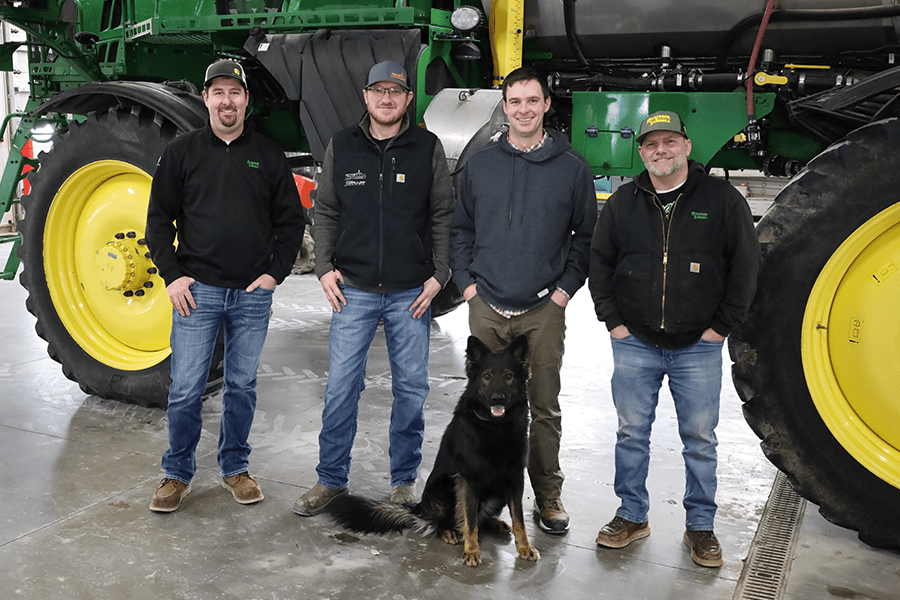
Precision spraying has become one of the most talked about advancements in modern agriculture—but what does it really look like after a full season in real fields?
In a recent episode of the Leap Forward Podcast, we traveled to Miller Farms in Pickett, Wisconsin, to hear firsthand from two growers who ran John Deere See & Spray™ across thousands of acres of corn and soybeans. Rather than focusing on demonstrations or theory, the conversation centered on real decisions made in the cab, real weed pressure, and real results.
Joining the discussion were Ryan Miller of Miller Farms and Jackson Remer of Remer Farms, alongside Tim Duel, Equipment Consultant with Riesterer & Schnell, and Nate Soltvedt, Application Specialist. What followed was an honest look at what worked, what surprised them, and how targeted spraying has changed the way they think about weed control.
Both farms entered the season with a healthy dose of skepticism. After years of keeping clean fields, the question wasn’t whether See & Spray sounded impressive—it was whether it could maintain the same standard without letting weeds slip through. To protect against that risk, both operators started the season running higher sensitivity settings, prioritizing coverage over chemical savings.
Their strategy was deliberate: run the system conservatively, learn how it responds under different field conditions, and only begin making adjustments once results could be evaluated. That approach allowed them to gain confidence without compromising weed control early in the season.
See & Spray was used on both corn and soybeans, paired with established chemical programs rather than experimental ones. In corn, applications included products such as Roundup, Diflexx, and Class Act—effective chemistry at a reasonable cost. In soybeans, higher priced combinations like Enlist and Liberty were more common, making targeted spraying especially valuable from a financial standpoint.
As the season progressed, both growers noticed something critical: the system was consistently detecting weeds that weren’t visible from the cab. Even small, early stage weeds were being identified and sprayed, reinforcing confidence in the technology’s accuracy.
That performance showed up clearly in the data. Soybeans averaged around 70 percent coverage, while corn typically ranged between 55 and 60 percent. These results were achieved while running cautious settings, suggesting more opportunity to reduce applied acres as familiarity increases. Soybeans, in particular, delivered strong returns by applying full rates only where weeds were present—an important consideration with today’s higher cost herbicide programs.
One of the biggest advantages of See & Spray was how accurately it reflected field variability. Low lying areas with poorer drainage and heavier weed pressure naturally triggered more spraying, often approaching full broadcast. Cleaner areas, including no till fields, required significantly less product. Seeing these patterns play out visually confirmed what operators already knew about their fields.
Sensitivity, speed, and lighting conditions all played a role in performance. Overcast days typically required higher sensitivity, while bright sunlight allowed operators to dial settings back. Speed management—particularly in turns—was also important, as higher boom speeds could push the system closer to broadcast spraying. Over time, operators learned that small, intentional adjustments made a measurable difference.
Operational flexibility was another unexpected benefit. Dual nozzle setups allowed operators to switch easily between See & Spray and ExactApply broadcast spraying, making it simple to handle pre emerge passes, custom work, or finishing a field when tank levels ran low. Mode changes were straightforward and didn’t disrupt daily workflows—an important factor for multi operator farms.
After harvest, that flexibility paid off again. Using See & Spray for fall burndown on soybean stubble, both growers targeted dandelions and other green material while spraying only about 40 percent of the field. This extended tank capacity, reduced refills, and helped set fields up cleaner for spring. For scattered acres and narrow fall weather windows, the efficiency was noticeable.
By season’s end, early skepticism had largely disappeared. Weed escapes were minimal, agronomists were impressed, and both operators felt confident in the technology’s performance.
Looking ahead, both farms plan to fine tune sensitivity settings, manage speed more intentionally, continue pairing targeted spraying with strong agronomy, and expand See & Spray into additional use cases.
See & Spray didn’t replace agronomy—it enhanced it. For these Wisconsin growers, learning to see weeds differently wasn’t about chasing technology. It was about spraying smarter, using less product where possible, and maintaining the clean fields they’ve worked hard to build.
Interested in learning more about See & Spray technology?
Contact your local Riesterer & Schnell team to learn how targeted spraying could work on your operation.


